Every day I walk my regular walk through the woods and along the valley in our region. Left or right, on narrow paths or I take a route through the forest, between the flowers and herbs I follow my path. .
My inspiration grows day by day to want to know more about the herbs I come across here, know the flowers by name, and what I can do or use with them.
Today I want to introduce you and tell you the story of this herb !
The perennial is native to Europe, but has spread further from there. It grows on poor sandy soil, and here in the mountains of the vipava , we have dry and poor soil. The herb begins flowering around St. John’s Feast on June 24, the time when the sun is at its highest, with yellow flowers and blooms from June to September.
So certainly for me, summer really starts on June 24, on the Christian holiday of St. John’s Day, the day on which the birth of the John the Baptist is commemorated. From that day on, you can harvest the flowers of St. John’s wort to process into medicinal products, because from St. John’s Day most of the sun power (energy) and healing power is stored in the herb.
St. John’s wort was used in ancient times as a cure for all kinds of ailments and to treat depressive feelings.
to treat burns.
Fighting fever and inducing periods
Among the ancient Germans, the red oil in St. John’s wort was regarded as the blood of the supreme god Wodan.
In the Middle Ages, the herb was used for its so-called magical powers, such as a protection against thunderstorms.
The fact that this herb can have such special properties really appeals to me.
Wonder and admiration for the ordinary, the obvious makes life attractive to me. Look around you and you need that wonder to enjoy a simple plant like St. John’s herb
Because if you look closely at this plant you will see something special. The back side of the leaves contain transparent dark dots and that is where the power lies!
St. John’s herb contains substances that have a strengthening effect on the nervous system and it calms down all kinds of complaints.
It is a natural antidepressant and can really help you when things are not going well and you feel lethargic and depressed. It offers guidance during difficult periods in your life, it gives you a piece of life courage and optimism.
Do you suffer from gloomy showers, an autumn dip or just because it is sometimes disappointing?
It helps with headaches, stress and extra tension due to external stimuli, insomnia and palpitations, or if you just don’t like it anymore.
Take a warm cup of tea with dried St. John’s herb.
It can really improve your mood and cheer you up. It provides a more positive outlook on life and this alone in the evening helps with insomnia and fatigue.
The tea also helps well against stomach and abdominal cramps.
It also stimulates blood flow, which makes it warm and relaxing for sore muscles and, for example, winter hands and feet.
The oil of the herb is dark red in color and helps very well with burns and sunburn . It soothes the skin , after sunburn or with winter hands. And don’t forget to tell, if you have some excess then this oil has a soothing and calming effect.
Furthermore, you can also use it as a massage oil for muscle and joint pain, because it has a warming effect and stimulates blood flow.
In addition, it has a disinfecting effect and can therefore be applied as a tincture to a wound or as drops in the ear in case of ear pain.
However, do not use St. John’s herb in oil form before going out into the sun, as it is photosensitive. When you will really notice an effect depends on the severity of your complaints and on the composition of the extract. Usually you start to notice the first effect after a week or 2 and after 4 to 6 weeks you will really see clear improvement in the symptoms.
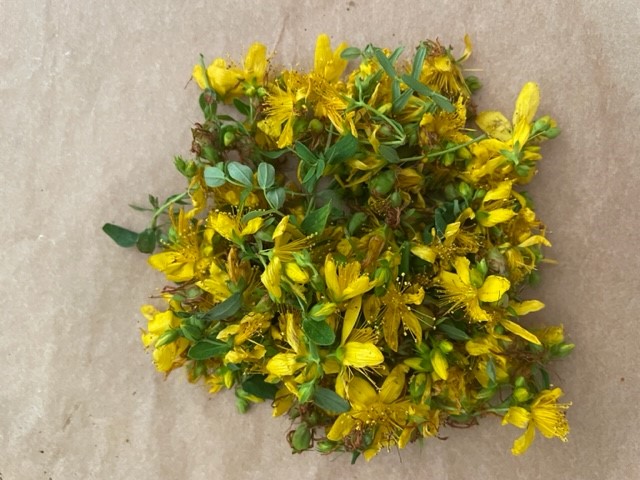
Every day, when it is dry and sunny, you pick the open flowers and the buds that are about to hatch around noon.
For me, St. John’s Day is really a festive day!

 go-camper-slovenia
Plaats een reactie